
Laparoscopic Ovarian Cyst Surgery
Ovarian cysts are fluid-filled sacs, usually benign, that many women encounter at some point in their lives. Most of the time, these cysts do not cause any symptoms and disappear on their own. However, in some cases the cysts may enlarge, burst or cause other complications. In such cases, surgical intervention may be required.
Today, one of the most preferred methods in the treatment of ovarian cysts is closed ovarian cyst surgery, also known as laparoscopic ovarian cyst surgery. This method, which offers many advantages for both patients and physicians, is among the groundbreaking minimally invasive techniques in women’s health.
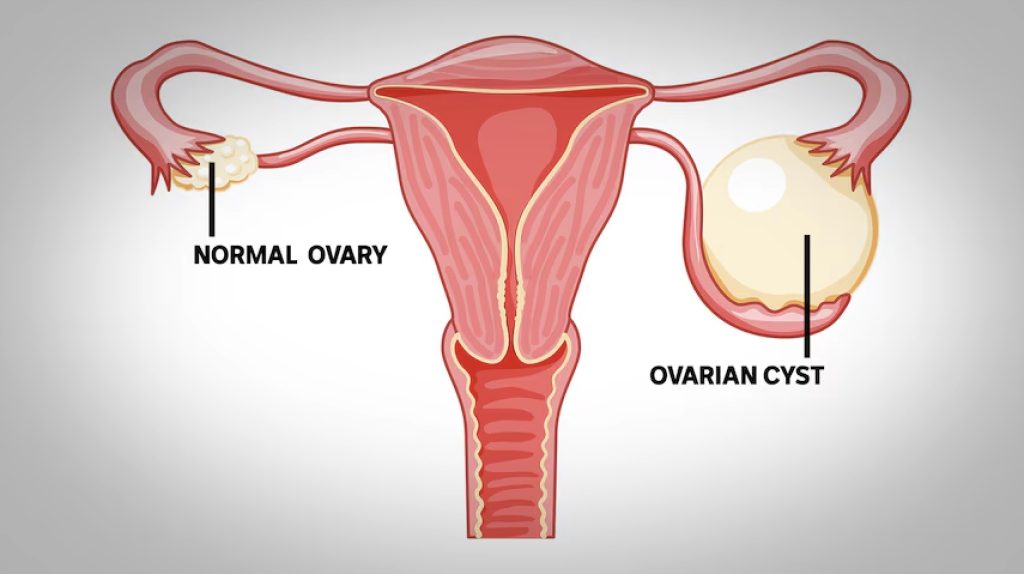
What is an ovarian cyst?
Ovarian cysts are fluid-filled sacs that form in or on the ovaries. These structures, usually called functional cysts, disappear spontaneously during the menstrual cycle. However, some cysts can grow, burst or cause torsion (rotation) and cause severe pain.
Types of Ovarian Cysts
- Functional Cysts – The most common type, usually harmless.
- Dermoid Cysts – These are structures that may contain tissues such as hair, skin or teeth.
- Endometrioma (Chocolate Cyst) – It develops due to endometriosis disease.
- Cystadenomas – Cysts that are filled with fluid or mucus and can grow.
- Polycystic Ovary Syndrome (PCOS) – Characterised by multiple small cysts.
What is Closed Ovarian Cyst Surgery?
Closed ovarian cyst surgery is a surgical procedure performed through small incisions in the abdomen. In this method, the internal organs are visualised on a high-resolution screen using a camera system called laparoscope and the cyst is removed with these images.
This method offers less pain, faster recovery and lower risk of complications compared to conventional open surgery.
In which cases is closed surgery necessary?
Not all ovarian cysts are treated with surgery. However, the following conditions may require surgery:
- If the diameter of the cyst is larger than 5 cm
- If the cyst continues to grow
- If there are risks such as pain, pressure, bursting or rotation in the cyst
- If there is a suspicion that the cyst is malignant
- If there is a potential that the cyst negatively affects the fertility
In such cases, your physician may recommend laparoscopic ovarian cyst surgery.

Preoperative Preparation
A detailed gynaecological examination is performed before the operation. The following examinations may then be ordered:
- Transvaginal or abdominal ultrasonography
- Blood tests (especially tumour markers such as CA-125)
- If necessary, advanced imaging methods such as MRI or CT
The patient should fast for a certain period of time before surgery and the necessary anaesthetic preparations should be completed. In addition, medications and existing diseases must be reported to the physician.
How is the operation performed?
Laparoscopic ovarian cyst surgery is performed under general anaesthesia. The procedure steps are as follows:
- Small incisions are performed in the lower abdomen.
- The abdominal cavity is inflated with carbon dioxide gas so that the organs can be seen easily.
- With the help of a laparoscope, the camera system is inserted inside.
- The ovarian cyst is removed with special surgical instruments.
- If necessary, the ovary is preserved and only the cyst is removed. In some cases, the ovary can also be removed.
- The incisions are closed after the bleeding is controlled.
How long does the operation take?
Although the duration of the operation varies depending on the size, type and location of the cyst, it takes an average of 60-120 minutes. This time is quite short in uncomplicated cases.
Postoperative Recovery Process
The recovery process after closed surgery is quite fast. Most patients are discharged on the same day or the next day. The things to be considered are as follows:
- There may be mild pain and gas complaints in the first few days.
- Heavy lifting and physical strain should be avoided.
- Within 1 week, daily activities can be resumed.
- Full recovery usually occurs within 2-3 weeks.
- Stitches are usually hidden, no bandage or stitch removal is required.
What are the Advantages of Closed Surgery?
Closed ovarian cyst surgery is superior to open surgery in many respects:
- Aesthetic appearance is not spoiled thanks to small incisions
- Less pain is felt
- Hospital stay is shorter
- Return to daily life is faster
- The risk of infection and bleeding is less
- It is easier to protect the ovaries
- It is more advantageous in terms of fertility
Is Closed Surgery Suitable for Every Cyst?
Although the closed method can be safely performed in many cases, open surgery may be preferred in some cases:
- If the cyst is very large (over 20 cm)
- If there is a suspicion of malignant tumour
- If there are dense adhesions due to previous surgeries
In such cases, the appropriate technique is selected according to the surgeon’s decision.
You can read my blog post for detailed information about uterine fibroid surgery (Myomectomy).
Can I Get Pregnant After Closed Ovarian Cyst Surgery?
This surgery does not adversely affect fertility. On the contrary, the chance of pregnancy may increase with the removal of cysts that may affect fertility. In surgeries performed by preserving the ovary, hormonal balance is not disturbed to a great extent.
However, in cases such as endometriosis or chocolate cysts, special attention to fertility may be required. For this reason, the patient’s desire for children must be evaluated when planning the operation.
Frequently Asked Questions
How long does ovarian cyst surgery take?
Closed surgery usually takes 60-120 minutes, but may vary depending on the size and type of cyst.
Is there pain after closed ovarian cyst surgery?
Yes, there is usually mild pain. This pain may be caused by gas and goes away spontaneously within a few days. It can be controlled with painkillers.
Will there be any stitches after the operation?
No, since the incisions are very small, the scars fade over time and do not create an aesthetically disturbing appearance.
When can I return to work after the surgery?
For desk jobs, it is possible to return within 5-7 days. It is healthier to wait 2-3 weeks for jobs that require physical effort.
Can ovarian cysts recur?
Some types of cysts can recur, especially chocolate cysts. Therefore, regular gynaecological controls are important.
When can I take a shower after closed surgery?
You can usually take a shower 2 days after the operation. However, care should be taken not to keep the incision sites moist.
When is sexual intercourse allowed after surgery?
Generally, there is no harm in having sexual intercourse after 2-3 weeks, after the doctor’s control.
Conclusion: A Safe and Modern Method for Women’s Health
Closed ovarian cyst surgery (Laparoscopic removal of ovarian cysts) is a modern treatment method that improves women’s quality of life, shortens the healing process and has minimal negative effects on fertility. If you are having problems with ovarian cysts, it would be the right step to consult a specialist in minimally invasive surgery field.
If you want to get more information about closed ovarian cyst surgery or to determine the most suitable treatment option for you, you can contact Prof. Dr. Şadıman Kıykaç Altınbaş, an obstetrician and gynaecologist in Ankara. Being guided by an experienced specialist will ensure that both the operation process is healthy and the right steps are taken in terms of fertility. You can contact us to make an appointment and get detailed information.
